Labels:
biochemicals,
Biofuels,
biomass,
carbon dioxide,
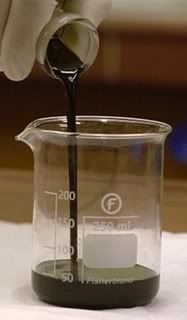
ethanol,
lactic acid. biodegradable plastic,
methane,
Netherlands,
oil palm,
Oil Palm Biomass Roadmap,
renewable resources,
sustainable solutions
 |
| Oil palm wastes |
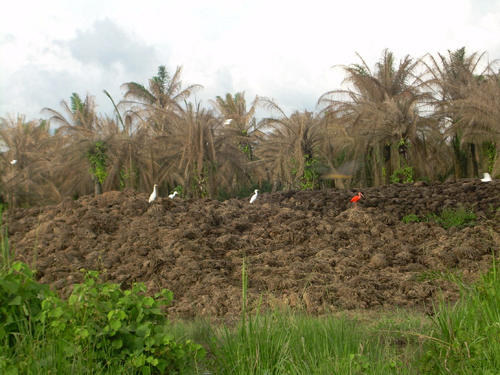
20/04/2011 (The Star) - Much of the 70 million tonnes of oil palm biomass produced annually is burnt or left to rot.
This waste pollutes rivers through seepage and harms the environment when it produces methane and carbon dioxide.
The Government has realised that oil palm biomass can be as valuable as crude palm oil and has come out with the Oil Palm Biomass Roadmap that will streamline efforts to convert this waste into wealth-generating industries.
Unik, an agency under the Prime Minister's Department to promote innovation, will undertake this project.
The agency will be collaborating with Dutch consortium BE-Basic to develop Malaysia's capabilities in using renewable resources for the production of chemicals, materials, products and fuels.
According to BE-Basic director Prof Dr Luuk van der Wielen, oil palm biomass would be able to contribute to the economy by as much as 5% if its use is widened to produce liquid biofuels and biochemicals.
“There's no technical barrier any more, it's a matter of making Malaysia attractive for companies to invest in this sector here, a matter of making connections to the plantation sector here,” he said in a recent report.
This development has also attracted foreign chemical companies which have invested by establishing demo-facilities in Malaysia.
Oil palm biomass can be converted into high-value chemicals such as ethanol and even higher value acids such as lactic acid, which is used in a wide range of food applications as well as the cosmetics industry and numerous biochemical processes.
It is also used as a monomer for producing polylactic acid, which has applications in biodegradable plastic.
Dr van der Wielen, who is also a professor at the department of biotechnology at Delft University of Technology, has been working with Universiti Teknologi Malaysia since 2009 to develop sustainable solutions for the chemical and fuel industry.
The Netherlands is the biggest consumer of palm oil in Europe.
The country is also currently the ninth largest export destination for Malaysia and third in the European Union.
Sustainable Solutions
15/04/2011 (City Journal) - We're less than 50 years from the end of world oil supplies at current consumption rates according to a new report by HSBC bank. That coming shortage has brought new calls for increased reliance on biofuels, including from President Obama in last month's energy speech. Biofuels are made from crops like corn, sugar, palm oil and cassava root which are harvested and then shipped to plants to be converted into fuels like ethanol.

While it's likely that biofuels will play a significant role in powering more efficient vehicles in the US and China, the poor nations that rely on these crops for food are facing rising rates of hunger and poverty as a result. Research by the World Bank found that an increase in biofuels production over 2004 levels would push more than 35mn additional people into absolute poverty, or an income of less than $1.25 per day. An analysis in the spring 2011 issue of The Journal of the Association of American Physicians and Surgeons, meanwhile, used statistics from the World Health Organisation (WHO) to estimate that our growing need for biofuels will result in at least 192,000 excess deaths from hunger and poverty every year. This is higher than the 141,000 deaths the WHO estimates to be caused by global warming each year.
The United Nations Food and Agriculture Organisation reports that 2011 has the highest food prices yet recorded. Despite the price of corn rising 73% in the US late last year, in part due to 40% of the crop now being used to make biofuel, Americans will probably only see a 2-3% increase in food prices in 2011. "For Americans it may mean a few extra cents for a box of cereal," said Marie Brill, senior policy analyst at ActionAid, an international development group. "But that kind of increase puts corn out of the range for impoverished people."
Though this year's skyrocketing food prices can also be attributed to high oil prices and severe weather events destroying crops in Russia and Australia, the market for biofuels also bears some responsibility. "What is certain is that biofuels are playing a role," said Oliver Dubois, a bioenergy expert at the Food and Agriculture Organisation in Rome.
This is especially true since many industrialised countries are aiming a transition from reliance on fossil fuels to greater use of biofuels.
Biofuels
BLOOMINGTON, Ind. -- The U.S. government supports domestic ethanol development to reduce America‘s oil dependence. Additionally, ethanol weakens OPEC’s control over world oil prices, reduces tailpipe pollutants and supplies extra octane that improves engine operation.
America‘s pro-ethanol policies include tax credits for businesses, support for research and development, tariffs on imported ethanol, rules requiring refiners to blend small amounts of ethanol with gasoline, and rules requiring automakers to produce cars that can run on gasoline or a mix of 85 percent ethanol and 15 percent gasoline (E85).
Due to large swings in oil prices, which are partly manipulated by OPEC, a domestic ethanol industry wouldn’t survive without government support. Countries with strong ethanol industries such as Brazil have pro-ethanol policies.
Now is a particularly dangerous time to eliminate federal support. OPEC‘s power will rise as the global economy recovers and as a strong appetite for oil in China and India continues to be satisfied.
If pro-ethanol policies were terminated immediately, U.S. taxpayers might benefit in the near term, but, in the long run, the real beneficiaries would be the oil barons in the Middle East, Venezuela and Russia.
Critics argue that more oil is used growing corn and making ethanol than is saved by replacing gasoline. In fact, the energy sources for producing ethanol are primarily natural gas and coal. Each 10 gallons of ethanol displaces at least five gallons of gasoline -- accounting for the fact that ethanol has somewhat less energy content than gasoline.
It’s valid to argue that hybrid and diesel engines reduce gasoline use at a lower cost than ethanol. But even more oil can be saved with hybrid engines running on E85 and trucks using biodiesel mixtures.
Critics claim that the sharp rise in corn prices was due to the increased use of corn-based ethanol. In reality, the big culprit was the growing demand for food worldwide.
While U.S. ethanol policies contributed to the rise temporarily, the effect could have been reduced if blending requirements had been phased in more gradually, allowing more time for corn supplies to respond.
Some fear that land clearing creates more carbon dioxide which exacerbates global warming. Modernized ethanol refineries supported by federal subsidies are now minimizing the land-use effect through more efficient farming and refining practices.
As new federal subsidies facilitate use of cellulosic ethanol made by producing ethanol from wastes such as the stalk of the corn and the cob, there will be less demand for land.
In addition, ethanol is particularly effective in reducing tailpipe emissions of carbon monoxide, nitrogen dioxide, and particulate matter. Ethanol pollutants such as formaldehyde are not harmful at the small concentrations projected for America‘s cities.
Although it’s unwise to pull the plug on ethanol, America‘s policies should be modernized. Refueling stations need stronger incentives to provide at least one E85 pump. Tax credits should be aimed at consumers who use E85 instead of businesses that already have a mandated market for their products. Tariffs on imported ethanol should be gradually reduced so the domestic industry has time to prepare for intensified competition.
Research and development support should be expanded to encourage innovation in the production of ethanol from agricultural waste, while rules requiring automakers to offer cars that can run on E85 should be tightened.
In order to minimize the environmental footprint of greater land use, subsidies for producers and farmers should encourage modern practices that maximize corn yield per acre and ethanol yield per bushel.
Commercial-scale demonstrations on how to make ethanol from the cob and stalk would ease concerns about food prices and land use.
Although America’s pro-ethanol policies are far from ideal, they should not be eliminated. Instead, they should be modernized to keep the competitive pressure on OPEC while improving urban air quality and reducing the environmental footprint of ethanol production.
By John D. Graham
John D. Graham is dean of Indiana University‘s School of Public and Environmental Affairs and author of “Bush on the Home Front.” He served as administrator of the Office of Management and Budget under President George W. Bush, and prior to that spent 16 years at Harvard’s School of Public Health. -- Ed.
(McClatchy-Tribune Information Services)
Ethanol